
Paying for college is one of the biggest financial decisions you will ever make, and if you are heading into the 2026 to 2027 academic year, the options can feel overwhelming. Tuition is climbing, acceptance rates are tightening, and many families are not sure where to start when it comes to funding a degree.

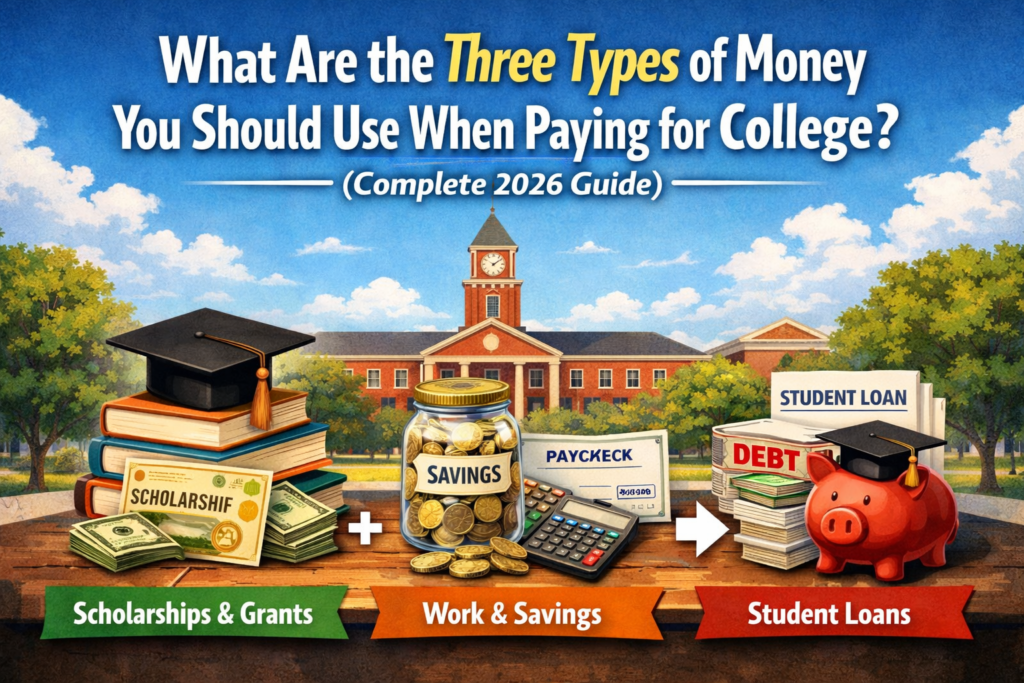
Here is the good news. You do not have to figure this out alone, and you do not have to drain your savings or take on massive debt to make college work. Financial aid experts consistently break down college funding into three core categories: free money, earned money, and borrowed money. If you use these three types of money in the right order, you can significantly cut what you actually pay out of pocket.
This guide is going to walk you through each type, explain exactly how it works in 2026, tell you where to find it, and show you how to combine all three into a smart, practical strategy. Whether you are a high school student preparing to apply, a current college student looking for more aid, or a parent trying to support a child through school, this breakdown is for you.
Let us get into it.
Understanding the Three Types of Money for College
Before jumping into details, here is the simple framework financial aid professionals use when they review your award package. Every dollar of college funding falls into one of three buckets.
- Free money is money you never have to pay back. This includes scholarships and grants.
- Earned money is money you work for through a part-time job arranged through your college. This is called work-study.
- Borrowed money is money you must repay with interest. This is your student loan category, including federal and private loans.
The golden rule that every financial aid counselor will tell you is this: always use free money first, then earned money, and only borrow what you absolutely need after exhausting the other two. When you follow this order, you protect yourself from graduating with a mountain of debt that takes years to pay off.
Now let us look at each one in detail.
Type 1: Free Money (Scholarships and Grants)
Free money is, without question, the best type of financial aid available to college students. It does not have to be repaid, it does not require you to work for it after the fact, and it can come from a surprisingly wide range of sources. This category includes both scholarships and grants, and while people often use these terms interchangeably, they are actually slightly different things.
What Is the Difference Between Scholarships and Grants?
Scholarships are typically awarded based on merit, meaning your academic performance, athletic ability, artistic talent, community involvement, or other personal achievements. They can also be need-based, meaning they consider your family’s financial situation alongside your accomplishments. Scholarships come from colleges and universities themselves, private organizations, businesses, nonprofits, community foundations, and even individuals who have set up funds in their name.
Grants, on the other hand, are almost always need-based. They are determined primarily by your financial situation rather than your grades or achievements. The biggest source of grants for college students in the United States is the federal government, specifically through the Free Application for Federal Student Aid (FAFSA).
Federal Grants Available in 2026
The most well-known federal grant program is the Pell Grant. For the 2026 to 2027 school year, the maximum Pell Grant award is $7,395. Eligibility is determined by your Student Aid Index (SAI), which replaced the old Expected Family Contribution formula, and is calculated directly from the information you submit on your FAFSA.
Beyond the Pell Grant, there are several other federal grant programs worth knowing about.
The Federal Supplemental Educational Opportunity Grant (FSEOG) is awarded to students with exceptional financial need. Unlike the Pell Grant, FSEOG funds are limited and go directly to colleges to distribute, so they are awarded on a first-come, first-served basis. Filing your FAFSA as early as possible is critical if you want to compete for this one.
The TEACH Grant is available specifically for students who plan to become teachers in high-need subject areas at low-income schools. It provides up to $4,000 per year, but be careful. If you do not fulfill the teaching service requirement after graduation, the grant converts into a loan that you must repay with interest.
The Iraq and Afghanistan Service Grant is available to students whose parent or guardian was a member of the U.S. armed forces and died as a result of service in Iraq or Afghanistan after September 11, 2001.
State Grants in 2026
Every state in the United States runs its own grant programs for residents attending in-state colleges. California has the Cal Grant, Illinois has the Monetary Award Program (MAP), New York has the Tuition Assistance Program (TAP), and so on. These programs are funded separately from federal aid and often have their own deadlines and eligibility requirements that go beyond just filing the FAFSA.
Many state grants are also distributed on a first-come, first-served basis, which means the earlier you file, the better your chances of receiving a larger award. Do not wait until summer to file your FAFSA and then expect state money to be waiting for you.
Institutional Grants and Scholarships
One of the most overlooked sources of free money comes from the colleges themselves. Many universities, especially private ones with large endowments, offer significant institutional grants to attract students. Private colleges now discount their tuition by an average of over 56 percent, which means the sticker price is almost never what families actually pay.
These institutional awards are often the largest single source of aid you can receive, and they are typically packaged into your financial aid award letter. Schools like to offer these discounts to admitted students they want to enroll, so do not assume a high-sticker-price private university is automatically out of reach. Always run the Net Price Calculator on a school’s website before ruling it out based on cost.
Private Scholarships
Outside of schools and governments, there is a massive universe of private scholarships offered by corporations, community organizations, professional associations, religious groups, and foundations. Collectively, around 5 million scholarships make approximately $24 billion available to students every year. Yet billions in Pell Grant money alone go unclaimed every year simply because students do not apply.
Private scholarships range from a few hundred dollars to full-ride awards that cover everything. Smaller local scholarships from community foundations and civic groups actually tend to have less competition and a better chance of winning than highly publicized national awards. It is worth applying for both.
You can search for scholarships relevant to your background, interests, and area of study using scholarship search databases. Some good places to start include the Federal Student Aid scholarship search tool, Fastweb, Scholarships.com, and Bold.org. Your high school guidance counselor and college financial aid office are also excellent resources for finding awards you might not find through a general internet search.
Explore free scholarship resources through the Federal Student Aid website to start building your application list today.
Key Things to Remember About Free Money
Always complete the FAFSA as early as possible. The 2026 to 2027 FAFSA opened on September 24, 2025. Most institutional priority deadlines fall in early March 2026. Missing those deadlines can cost you thousands of dollars in free aid.
Check whether each scholarship or grant is renewable. Some are one-time awards while others can be renewed each year as long as you maintain a certain GPA or meet other requirements. A renewable $2,000 scholarship is worth $8,000 over a four-year degree.
Read the fine print on every grant you receive. Some, like the TEACH Grant, come with service conditions. If you fail to meet those conditions, you will owe the money back.
Type 2: Earned Money (Federal Work-Study)
The second type of money for college is earned money, and in the financial aid world, this refers specifically to the Federal Work-Study (FWS) program. Work-study is a federally funded program that provides part-time employment to students who demonstrate financial need, allowing them to earn money to help cover their education expenses.
How Does Work-Study Work?
If you are eligible for work-study, it will appear as a line item in your financial aid award letter. The dollar amount listed is the maximum you can earn through the program for that academic year. You do not receive this money upfront. Instead, you work a part-time job and receive a paycheck, just like any other job.
Work-study jobs are available both on campus and off campus with approved community service or government organizations. Common positions include library assistant, campus tour guide, office assistant, tutor, computer lab technician, and event staff. Some positions that require specific skills can pay above minimum wage, though most start at minimum wage or just above.
Your college’s financial aid office and student employment office manage the work-study program and post available positions. Apply early because the most desirable campus jobs fill up quickly, especially at the start of each academic year.
Why Work-Study Is Better Than a Regular Part-Time Job for College Students
You might wonder why work-study matters if you could just get any regular part-time job while in school. There are a few important advantages to work-study specifically.
First, work-study earnings are not counted as income in the same way when you file your next year’s FAFSA. This is a big deal. Regular part-time job income could reduce your eligibility for need-based aid in future years. Work-study income is treated differently in the financial aid calculation, which helps protect your aid package.
Second, the jobs are designed to be flexible around your class schedule. Employers who participate in work-study programs understand that students have academic priorities, and they structure the positions accordingly.
Third, work-study jobs, especially on-campus ones, are often more convenient, safer, and easier to balance with coursework than off-campus employment.
What If You Do Not Qualify for Work-Study?
Work-study eligibility is based on financial need as determined by your FAFSA. If you do not qualify for the federal program, some states run their own work-study programs as well. You can also simply find a part-time job independently, which still helps you earn money for college expenses, even if it does not carry the same FAFSA advantages as official work-study employment.
The important thing is that you prioritize earning money before turning to loans. Even a modest part-time income of a few thousand dollars per year can meaningfully reduce how much you need to borrow.
Type 3: Borrowed Money (Student Loans)
The third type of money for college is borrowed money, meaning student loans. Loans are the category most families are familiar with, and unfortunately, they are often the one that gets relied on too heavily before exhausting free and earned money options first.
Student loans must be repaid with interest. That means you will pay back more than you originally borrowed, and depending on how much you borrow, the repayment burden can follow you for a decade or more after graduation. That does not mean loans are automatically bad. For many students, borrowing a reasonable amount to complete a degree that improves their long-term income is a smart investment. The key word is reasonable.
Federal Student Loans Versus Private Student Loans
There are two main categories of student loans: federal loans and private loans. You should always prioritize federal loans and treat private loans as an absolute last resort.
Federal student loans come from the U.S. Department of Education and carry fixed interest rates that are set each July 1. They come with significant protections that private loans do not offer, including income-driven repayment plans, deferment and forbearance options, loan forgiveness programs like Public Service Loan Forgiveness (PSLF), and, in some cases, subsidized interest while you are still in school.
There are three main types of federal loans available to undergraduate students.
Direct Subsidized Loans are need-based. The federal government pays the interest on these loans while you are enrolled in school at least half-time, during the grace period after you leave school, and during any periods of deferment. This is a significant benefit that saves you money over the life of the loan. Dependent undergraduate students can borrow up to $31,000 in federal loans total across their entire education.
Direct Unsubsidized Loans are not need-based, meaning any student who files the FAFSA can qualify regardless of family income. However, interest begins accruing immediately from the time the loan is disbursed. If you do not pay the interest while in school, it capitalizes, meaning it gets added to the principal balance, and then you end up paying interest on your interest.
Direct PLUS Loans for parents (called Parent PLUS Loans) allow parents of dependent undergraduate students to borrow money to help cover education costs. These loans require a credit check and carry higher interest rates than the standard Direct Subsidized and Unsubsidized Loans. Repayment is the sole responsibility of the parent, not the student.
Private Student Loans
Private student loans come from banks, credit unions, and private lenders. They typically require a credit check, and most undergraduate students will need a cosigner because they do not yet have an established credit history. Interest rates on private loans can be variable rather than fixed, which means your rate and monthly payment could increase over time.
Private loans do not come with the same income-driven repayment plans or forgiveness options that federal loans do. Once you borrow private money, your options for managing that debt are far more limited if you hit financial hardship after graduation.
The advice from financial aid professionals is consistent: max out your federal loan options before ever touching a private loan, and even then, borrow private money only as a last resort after all other funding sources have been exhausted.
How Much Should You Borrow?
A commonly cited guideline is to avoid borrowing more in total student loan debt than you expect to earn in your first year of salary after graduation. If you are going into a field where starting salaries are typically around $45,000, try not to graduate with more than $45,000 in total student loan debt. This keeps your monthly payments manageable on an entry-level income.