In this complete guide, we’ll break down:
- The three types of money you should use when paying for college
- Why the order matters
- How to maximize each funding type
- Common mistakes students make
- Expert tips to reduce or eliminate student loan debt
What Are the Three Types of Money You Should Use When Paying for College?
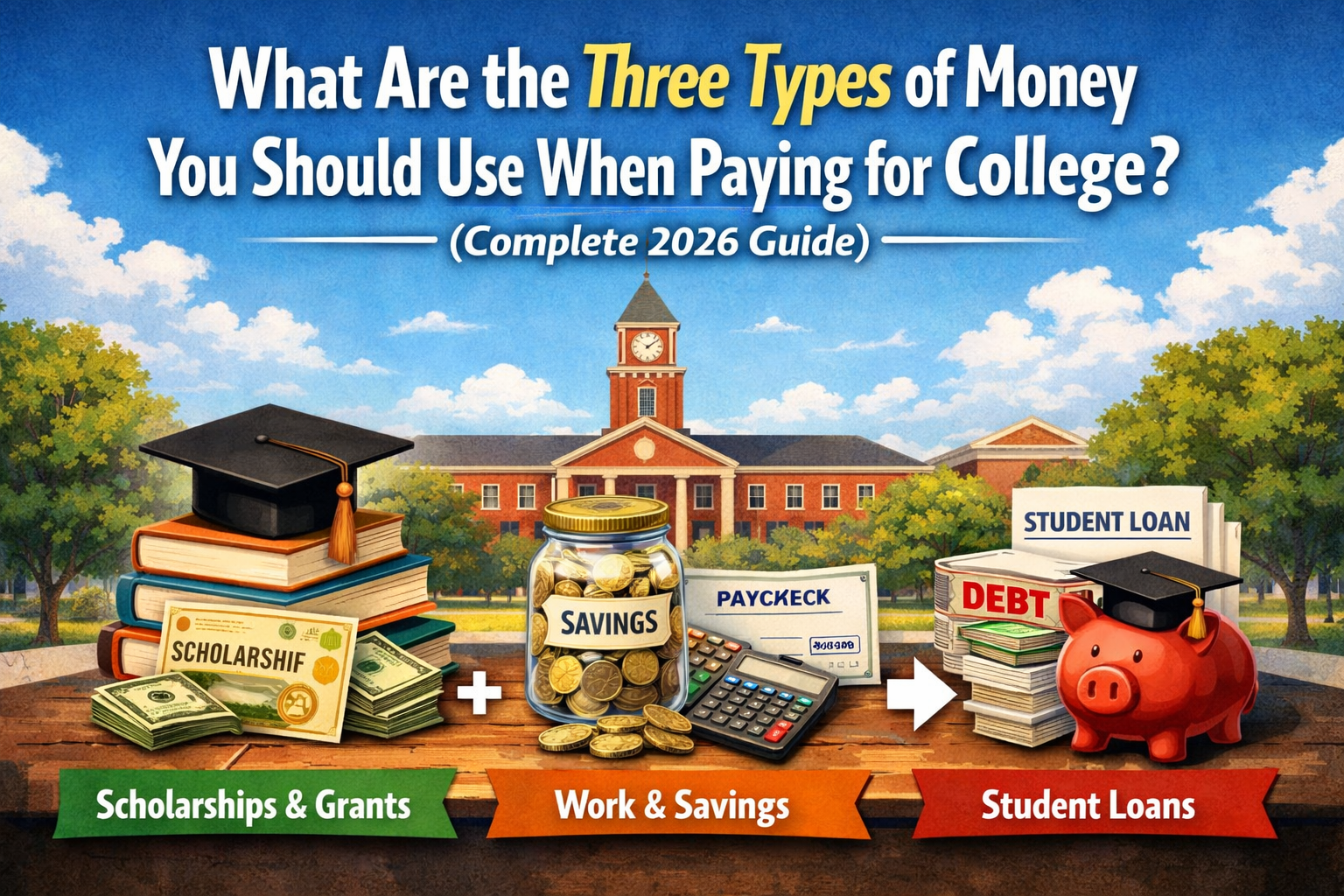
The three types of money you should use when paying for college — in the smartest order — are:
- Free Money (Scholarships & Grants)
- Earned Money (Work & Savings)
- Borrowed Money (Student Loans)
This order is critical. Always use free money first, then money you earn, and finally borrowed money only if necessary.
Let’s break down each type in detail.
1. Free Money: Scholarships and Grants (Money You Don’t Pay Back)
The first and most important answer to what are the three types of money you should use when paying for college is free money.



Free money includes:
- Federal grants
- State grants
- Institutional grants
- Private scholarships
- Merit-based scholarships
- Need-based scholarships
Federal Grants
One of the most well-known federal grants is the Federal Pell Grant. Pell Grants are awarded to undergraduate students with financial need and do not need to be repaid.
To qualify for federal grants, students must complete the FAFSA (Free Application for Federal Student Aid). The FAFSA determines your eligibility for:
- Pell Grants
- Federal Supplemental Educational Opportunity Grants (FSEOG)
- Federal Work-Study
- Federal student loans
State Grants
Most U.S. states offer grant programs to residents attending in-state colleges. These grants are usually need-based and can significantly reduce tuition costs.
Check your state’s higher education agency website for eligibility details.
Institutional Grants
Colleges themselves offer grants based on academic achievement, financial need, or special talents. Always contact your school’s financial aid office to ask about internal grant opportunities.
Private Scholarships
Private organizations, nonprofits, and corporations offer scholarships year-round. Use reputable search platforms like:
Why Free Money Should Always Come First
Free money reduces your total cost of attendance without creating future debt. Every dollar you receive in scholarships or grants is a dollar you won’t need to borrow.
If your college costs $25,000 per year and you receive $10,000 in grants and scholarships, you only need to cover $15,000.
This is why free money is the first answer to the question: what are the three types of money you should use when paying for college?
Also Apply For DAAD Scholarship 2026
2. Earned Money: Work and Savings
The second type of money you should use when paying for college is earned money. This includes:
- Personal savings
- Family contributions
- 529 college savings plans
- Part-time jobs
- Federal Work-Study earnings
Personal Savings
If you’ve saved money during high school or gap years, using it wisely can reduce borrowing. However, avoid draining emergency savings completely.
529 College Savings Plans
A 529 plan is a tax-advantaged savings account specifically for education expenses. Withdrawals for qualified education expenses are tax-free.
Many families use 529 plans to reduce out-of-pocket tuition costs.
Federal Work-Study
The Federal Work-Study Program provides part-time jobs for students with financial need.
Benefits include:
- Flexible schedules
- On-campus employment
- Reduced need for loans
Part-Time Jobs
Working 10–20 hours per week can cover books, transportation, and personal expenses. Many students balance work and academics successfully.
Why Earned Money Comes Second
Earned money does not create debt, but it does require time and effort. It’s more flexible than loans and allows you to graduate with less financial burden.
3. Borrowed Money: Student Loans
The third type of money you should use when paying for college is borrowed money — and it should be used only after maximizing free and earned money.
Student loans fall into two main categories:
- Federal student loans
- Private student loans
Federal Student Loans
Federal loans are issued by the U.S. Department of Education. Types include:
- Direct Subsidized Loans
- Direct Unsubsidized Loans
- PLUS Loans
Subsidized loans are preferable because the government pays interest while you’re in school.
Private Student Loans
Private loans come from banks and financial institutions. They often have:
- Higher interest rates
- Less flexible repayment options
- Credit-based approval requirements
Always compare lenders carefully and exhaust federal options first.
Why Loans Should Be Last
Loans must be repaid with interest. A $30,000 loan at 6% interest can cost over $40,000 by the time it’s fully repaid.
This is why loans are the final step when answering what are the three types of money you should use when paying for college.
The Smart Order for Paying for College
Here’s the ideal strategy:
- Apply for FAFSA early
- Maximize grants and scholarships
- Use savings and work income
- Borrow federal loans if necessary
- Avoid private loans whenever possible
Common Mistakes Students Make
- Not applying for FAFSA
- Missing scholarship deadlines
- Borrowing more than needed
- Choosing private loans first
- Ignoring work-study opportunities
Expert Tips to Reduce College Costs
- Start at community college and transfer
- Live at home if possible
- Buy used textbooks
- Apply for scholarships every year
- Choose in-state public universities
Final Thoughts: The Right Way to Pay for College
To summarize, the answer to what are the three types of money you should use when paying for college is clear:
- Free Money (Scholarships & Grants)
- Earned Money (Work & Savings)
- Borrowed Money (Loans)
Following this order can save you thousands of dollars and help you graduate with minimal debt.
College is an investment in your future — but it shouldn’t trap you in decades of repayment. Be strategic, apply early, and prioritize funding sources wisely.
By understanding and applying these three types of money in the correct order, you’ll position yourself for financial success long after graduation.