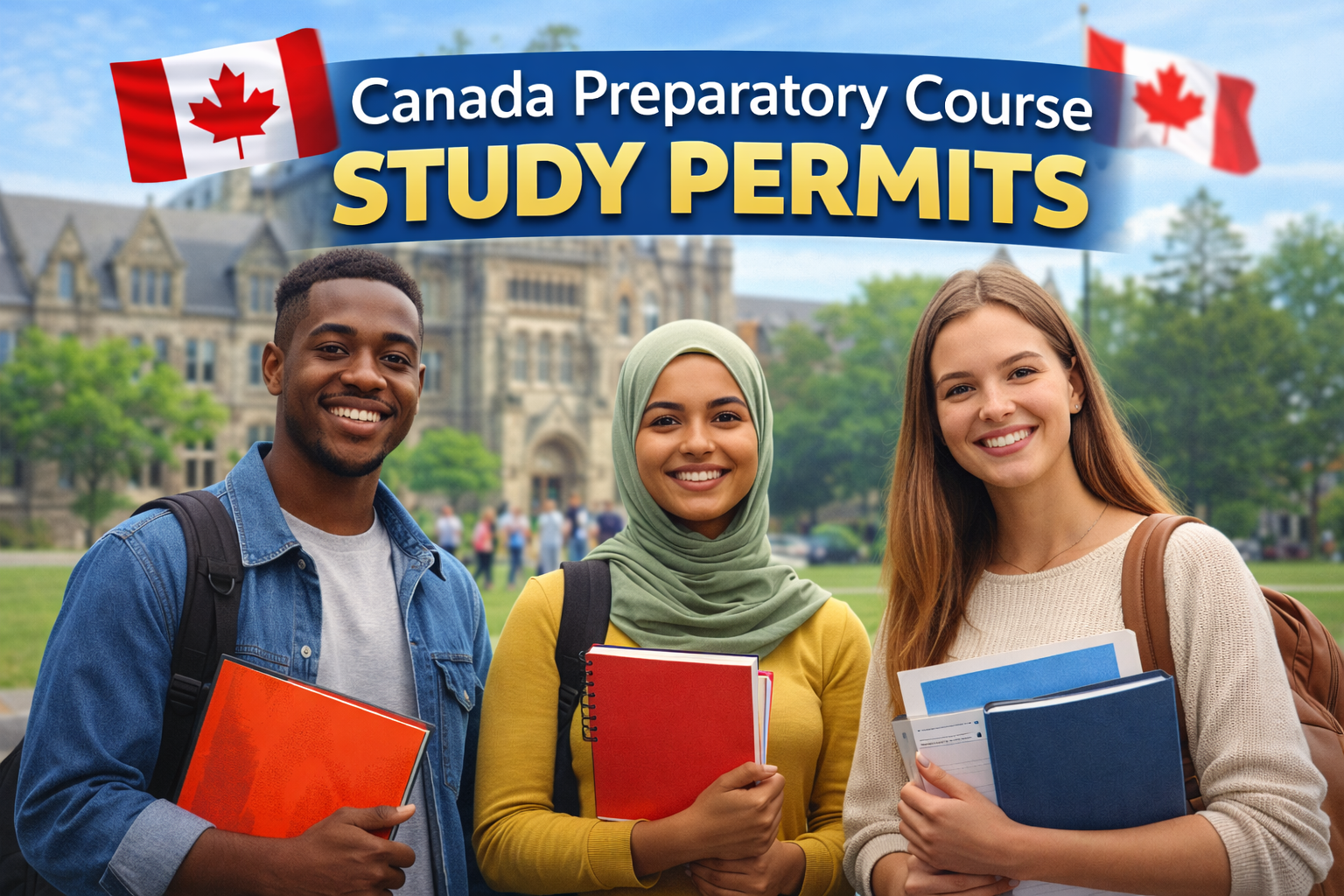
If you’re planning to study in Canada in 2026 and want to enroll in a preparatory course whether that’s university foundation programs, language preparation classes, or pathway programs you’ll likely need a Canada preparatory course study permit. This permit allows international students to undertake pre-degree or preparatory studies in Canadian institutions while legally residing in Canada.
Preparatory courses in Canada help international students bridge gaps in language proficiency, academic readiness, or specialized subject preparation before entering main diploma or degree programs.
This detailed guide covers everything you need to know about Canada preparatory course study permits, including eligibility requirements, the application process, required documentation, timelines, costs, and expert tips to strengthen your chances of approval.
What Are Canada Preparatory Course Study Permits?
A Canada study permit is an official authorization from Immigration, Refugees and Citizenship Canada (IRCC) that allows international students to study at designated learning institutions (DLIs) in Canada for a defined period. A preparatory course study permit specifically applies to pre-university, foundation, pathway, or intensive English/French programs that prepare students for full academic degree or diploma programs.
These programs are especially useful for students who:
- Need additional time to improve language proficiency (e.g., English or French)
- Require academic bridging before entering undergraduate or postgraduate programs
- Seek pathway programs designed in partnership with universities or colleges
Without a valid study permit, you cannot legally undertake full-time preparatory programs in Canada unless your course is very short and exempt under IRCC rules (e.g., courses shorter than 6 months that do not require a permit). Most preparatory courses exceed this duration and therefore require a permit.


Why Canada Preparatory Courses Are Popular in 2026
Canada continues to be one of the most sought-after destinations for international students due to its high-quality education, multicultural environment, post-study work opportunities, and immigration pathways. Preparatory courses add significant value because they:
- Help students acclimate to the Canadian education system
- Provide essential academic and language readiness
- Increase chances of success in degree programs
- Are often part of structured pathway agreements with universities
Many students from India, Nigeria, China, Pakistan, and other international markets choose preparatory programs as a strategic step toward obtaining undergraduate or graduate Canadian study permits.
Difference Between Preparatory Courses and Other Study Programs
Preparatory courses are distinct from other programs in several ways:
| Program Type | Main Purpose | Permit Requirement |
|---|---|---|
| Preparatory Courses | Preparation for academic study or language proficiency | Yes (if full-time & longer than 6 months) |
| Undergraduate Degree | Bachelor’s level studies | Yes |
| Graduate Degree | Masters/PhD level studies | Yes |
| Short Courses (Less than 6 months) | Skill enhancement or certifications | Often exempt |
Preparatory courses are a recognized pathway in Canada’s education ecosystem. Many students choose them to strengthen academic readiness, especially where direct entry to degree programs is competitive or challenging.
Types of Preparatory Programs in Canada
Preparatory courses can vary depending on the institution and academic goals:
- Language Preparatory Programs — Focus on English or French language proficiency.
- Academic Foundation Programs — Provide core academic skills (e.g., mathematics, science basics).
- University Pathway Programs — Structured with partner universities for seamless degree entry upon completion.
- Bridge Programs — Help international students meet academic prerequisites for degree programs.
Many colleges and universities in Canada offer these programs. Confirm that your chosen institution is a Designated Learning Institution (DLI) as required by IRCC.
How Preparatory Courses Support Long-Term Academic Goals
Completing a preparatory course can lead to:
- Conditional acceptance into degree programs
- Improved academic foundation for success in higher studies
- Opportunity to secure scholarships or academic exemptions
- Development of Canadian academic norms and study culture
Preparatory program success is often a key step in strengthening your application for future study permits or permanent residency pathways in Canada.
Eligibility Requirements for Canada Preparatory Course Study Permits 2026
Meeting the eligibility requirements is one of the most critical aspects of obtaining a Canada preparatory course study permit. Immigration, Refugees and Citizenship Canada (IRCC) carefully evaluates applicants to ensure they are genuine students with clear academic intentions and sufficient resources to support themselves during their stay.
Below are the core eligibility requirements international students must meet when applying for a preparatory course study permit in 2026.
Acceptance from a Designated Learning Institution (DLI)
You must have an official Letter of Acceptance (LOA) from a Canadian Designated Learning Institution. A DLI is an institution approved by provincial or territorial governments to host international students.
You can verify whether an institution is a DLI through the official IRCC list:
Designated Learning Institutions in Canada.
Your LOA should clearly state:
- The name of the preparatory course
- Program duration
- Start and end dates
- Tuition fees
- Any conditions tied to future degree admission
Proof of Financial Support
Applicants must demonstrate they have sufficient funds to cover:
- Tuition fees for the preparatory course
- Living expenses in Canada
- Return transportation costs
As of current IRCC guidelines, students generally need to show:
- At least CAD $10,000 per year for living expenses (outside Quebec)
- Additional funds for accompanying family members
Acceptable proof of funds includes:
- Bank statements (last 6 months)
- Proof of paid tuition
- Guaranteed Investment Certificate (GIC)
- Sponsorship letters with financial evidence
Academic Background and Educational Purpose
IRCC assesses whether your academic background aligns with the preparatory course you are applying for. You must clearly explain why the preparatory course is necessary for your academic progression.
Strong applications usually show:
- Logical academic progression
- Clear gaps the preparatory program will address
- Future plans to enroll in a degree or diploma program
A detailed Statement of Purpose (SOP) is essential to justify your need for a preparatory program rather than direct degree admission.
Language Proficiency (If Required)
While some preparatory courses are designed to improve language skills, many institutions still require basic proficiency levels.
Accepted language tests may include:
- IELTS Academic
- TOEFL iBT
- Duolingo English Test
- French language tests (for French-taught programs)
Language requirements vary by institution, so applicants should always confirm requirements directly with their chosen school.
Genuine Temporary Resident Requirement
Applicants must convince IRCC that they are genuine temporary residents who will leave Canada after completing their studies or transition legally into another approved status.
Visa officers consider:
- Ties to home country (family, employment, property)
- Study plan credibility
- Immigration history
- Overall application consistency
Medical and Security Clearance
Depending on your country of residence and program length, you may need to:
- Undergo a medical examination by an IRCC-approved physician
- Provide police clearance certificates
Medical exam requirements are outlined on the official IRCC page:
IRCC Medical Exams.
2026 Jim Ovia Scholarship in Nigeria – Requirements, Eligibility, Process
Who Should Consider a Preparatory Course Study Permit?
Canada preparatory course study permits are ideal for students who:
- Do not meet direct entry requirements for degree programs
- Need to improve English or French proficiency
- Have academic gaps or non-traditional education backgrounds
- Want a structured pathway into Canadian universities
Choosing a preparatory course is a strategic decision that can significantly increase academic success and long-term opportunities in Canada.
Application Process for Canada Preparatory Course Study Permits 2026
Understanding the application process for Canada preparatory course study permits is essential for avoiding delays or refusals. Immigration, Refugees and Citizenship Canada (IRCC) uses a structured process designed to verify student intent, eligibility, and documentation accuracy.
Below is a step-by-step breakdown of how international students can successfully apply for a preparatory course study permit in 2026.
Step 1: Secure Admission to a Preparatory Program
The first step is to apply and gain admission to a recognized preparatory course offered by a Designated Learning Institution (DLI) in Canada.
During the application process, institutions may assess:
- Academic transcripts
- Language proficiency
- Previous education gaps
- Motivation for preparatory study
Once accepted, the institution issues a Letter of Acceptance (LOA), which is mandatory for the study permit application.
Step 2: Create an IRCC Online Account
Most students apply for a study permit online through the IRCC portal:
An online account allows applicants to:
- Submit applications electronically
- Upload supporting documents
- Track application status
- Receive messages from IRCC
Step 3: Complete the Study Permit Application Form
Applicants must accurately complete the study permit application form, providing personal information, travel history, educational background, and study intentions.
Key areas that require careful attention include:
- Purpose of study in Canada
- Details of the preparatory course
- Financial capacity declarations
- Past visa refusals (if any)
Any inconsistencies or omissions can lead to processing delays or refusal.
Step 4: Upload Supporting Documents
All required documents must be uploaded in clear, legible formats. These documents support your eligibility and intent as a genuine student.
Common supporting documents include:
- Letter of Acceptance from a DLI
- Proof of financial support
- Statement of Purpose
- Academic transcripts and certificates
- Language test results (if applicable)
- Valid passport
Detailed document requirements will be covered fully in Part 4.
Step 5: Pay Application Fees
Applicants are required to pay:
- Study permit application fee (CAD $150)
- Biometrics fee (CAD $85, if applicable)
Fees are paid online via the IRCC portal using accepted payment methods.
Step 6: Biometrics Submission
After submitting the application, applicants may receive a Biometrics Instruction Letter (BIL). Biometrics must be submitted at an approved Visa Application Centre (VAC).
You can locate the nearest VAC here:
Find a VAC.
Step 7: Medical Examination (If Required)
Some applicants must complete a medical exam based on:
- Country of residence
- Length of stay in Canada
- Field of study
Medical exams must be conducted by IRCC-approved panel physicians.
Step 8: Application Processing and Decision
Processing times vary by country and application volume. Students applying early for the 2026 intake benefit from faster decisions and better preparation timelines.
Applicants can monitor processing times here:
Check IRCC Processing Times.
Step 9: Port of Entry Letter and Arrival in Canada
If approved, applicants receive a Port of Entry (POE) Letter. This letter is presented to border officers upon arrival in Canada, after which the actual study permit is issued.
Students must carry:
- POE Letter
- Letter of Acceptance
- Proof of funds
- Valid passport
Common Mistakes to Avoid During the Application Process
- Weak or generic Statement of Purpose
- Insufficient proof of funds
- Unclear academic progression
- Applying too close to intake deadlines
- Inconsistent documentation
A well-prepared application significantly increases approval chances for Canada preparatory course study permits.
Charity Kpabep Scholarship 2026 for Female Engineers – Apply Now
Documents Needed for Canada Preparatory Course Study Permits 2026
Submitting complete, accurate, and well-organized documentation is one of the most important factors in securing approval for Canada preparatory course study permits. Immigration officers rely heavily on documents to assess eligibility, intent, and financial capability.
This section provides a detailed breakdown of all documents required for a successful application in 2026.
Letter of Acceptance (LOA)
The Letter of Acceptance from a Canadian Designated Learning Institution (DLI) is the foundation of your study permit application.
Your LOA must clearly include:
- Name of the preparatory course
- Institution name and DLI number
- Program start and end dates
- Tuition fees and payment schedule
- Any conditions related to future academic progression
Without a valid LOA, a study permit application cannot proceed.
Proof of Financial Support
Applicants must demonstrate sufficient financial capacity to support themselves during their stay in Canada.
Acceptable financial documents include:
- Personal or sponsor bank statements (last 6 months)
- Proof of tuition payment or deposit
- Guaranteed Investment Certificate (GIC)
- Scholarship or funding letters
- Affidavit of financial support (if sponsored)
Financial documents should clearly show:
- Account holder name
- Transaction history
- Consistent fund availability
- Currency and bank verification
Statement of Purpose (Study Plan)
The Statement of Purpose (SOP) is one of the most critical documents for preparatory course applicants. It explains your academic background, career goals, and why the preparatory course is necessary.
A strong SOP should address:
- Your academic history and any gaps
- Why you chose the specific preparatory program
- How the course aligns with your future degree plans
- Your intent to comply with Canadian immigration laws
- Your plans after completing studies
Clear, honest, and well-structured SOPs significantly increase approval chances.
Academic Transcripts and Certificates
Applicants must submit official academic records from previously completed education.
These typically include:
- High school certificates and transcripts
- Diplomas or degrees (if applicable)
- Grading scales or result explanations
Documents not in English or French must be accompanied by certified translations.
Language Proficiency Test Results
Depending on the preparatory program, language test results may be required.
Accepted tests often include:
- IELTS Academic
- TOEFL iBT
- Duolingo English Test
- Approved French language tests
Always check institution-specific language requirements before submission.
Valid Passport
Your passport must be:
- Valid for the entire duration of your studies
- Contain at least one blank page
Short passport validity may result in a limited study permit duration.
Digital Photo
A recent passport-sized digital photo meeting IRCC specifications is required.
Photo guidelines can be found here:
IRCC Photo Specifications.
Medical Examination Results (If Applicable)
Medical exams are required for applicants from certain countries or for programs exceeding six months.
Medical exams must be conducted by IRCC-approved panel physicians listed here:
IRCC Medical Exams.
Police Clearance Certificate (If Required)
Some applicants may be asked to provide police clearance certificates to demonstrate good character and admissibility.
Additional Supporting Documents
Depending on individual circumstances, IRCC may request:
- Proof of ties to home country
- Employment letters
- Resume or CV
- Family information forms
Document Formatting and Submission Tips
- Upload clear, high-resolution scanned documents
- Ensure file names are accurate and descriptive
- Combine related documents into single PDF files where required
- Translate all non-English/French documents professionally
Well-organized documentation improves processing efficiency and reduces the likelihood of refusals.
Timelines, Validity, and Transition After Canada Preparatory Courses
Planning ahead is essential when applying for Canada preparatory course study permits, especially for the 2026 intake. Understanding timelines, permit validity, and transition pathways helps international students stay compliant and maximize long-term academic opportunities in Canada.
Recommended Application Timeline for 2026
Students are strongly advised to begin preparations well in advance. A typical recommended timeline includes:
- 12–15 months before intake: Research preparatory programs and institutions
- 10–12 months before intake: Apply to Canadian institutions
- 8–10 months before intake: Receive Letter of Acceptance
- 6–8 months before intake: Submit study permit application
- 3–6 months before intake: Receive decision and prepare travel
Early applications reduce processing stress and allow time to address additional document requests.
Study Permit Validity for Preparatory Courses
The validity of a Canada preparatory course study permit typically covers:
- The full length of the preparatory program
- An additional 90 days after program completion
This extra period allows students to:
- Apply for a study permit extension
- Transition to a degree or diploma program
- Prepare for departure if not continuing studies
Extending Your Study Permit After a Preparatory Course
Students who successfully complete a preparatory course and receive admission to a full academic program must apply for a study permit extension before their current permit expires.
Extension applications are submitted through IRCC:
Extend Your Study Permit.
Required documents typically include:
- New Letter of Acceptance
- Updated proof of funds
- Academic completion confirmation
Transitioning from Preparatory Programs to Degree Studies
Many preparatory programs are designed as formal pathways into undergraduate or postgraduate programs. Upon successful completion, students may receive:
- Conditional or guaranteed admission to partner institutions
- Academic credit or language exemptions
- Reduced transition requirements
Maintaining good academic standing is essential to ensure seamless transition.
Work Opportunities During Preparatory Courses
International students enrolled in full-time preparatory programs may be eligible to work:
- Up to 20 hours per week during academic sessions
- Full-time during scheduled breaks (if permitted)
Work eligibility depends on:
- Program classification
- Institution policies
- Study permit conditions
Students should always confirm work authorization details on their permit.
Long-Term Benefits of Canada Preparatory Courses
Completing a preparatory program in Canada offers several long-term advantages:
- Smoother academic adjustment
- Higher degree program success rates
- Access to post-graduation work opportunities
- Stronger pathways toward permanent residence
Preparatory courses are often the foundation for successful academic and professional futures in Canada.
Final Expert Tips for Study Permit Approval in 2026
- Choose recognized DLIs with strong pathway programs
- Write a clear, honest, and logical Statement of Purpose
- Demonstrate strong financial stability
- Apply early and track application progress
- Ensure all documents are accurate and consistent
With careful preparation, strong documentation, and a clear academic plan, securing a Canada preparatory course study permit in 2026 is a realistic and achievable goal.